Showing posts with label Drama. Show all posts

Wednesday, 1 May 2013

Short review: Cosmopolis

Director: David Cronenberg
(2012)

I’m going to be completely honest here, I’ve just finished watching Cosmopolis for the first time and I have no idea what just happened. A lot of films require the audience to meet the film half way in order to fully appreciate and enjoy the movie, but Cosmopolis simply isn’t that kind. It demands your undivided attention and a considerable amount of effort, Robert Pattison’s bizarre limo ride around Manhattan is a surreal and mystifying experience. Yet the film is still an absolute joy to watch, primarily due to the electrifying dialogue and breakneck pace set by some sublime editing. The little story we do get is a borderline commentary on money and capitalism, but this is easily overshadowed by Pattison’s excellent turn as a self-destructive multi billionaire. Its total lack of substance will bewilder the majority of audiences, but this is certainly a fresh cinematic experience.


Friday, 19 April 2013

Short review: Trance

Director: Danny Boyle
(2013)

In his 19 years of making films, Trance, Danny Boyles latest, is the first that could be considered a complete let down. The premise of the film seems relatively simple, a botched art heist puts a criminal (Vincent Cassel) the amnesiac, double crossing thief (James McAvoy) and his hypnotherapist (Rosario Dawson) on a trippy, mind bending venture in order to uncover the hidden location of the painting. While the film possesses decent cinematography and performances, the narrative is a complete shambles; a mess of plot arcs and dream sequences bog the film down from the get go. It leaves the audiences head spinning aimlessly, a far cry from other, smarter crime thrillers in recent years (Shutter Island, Inception). The story twists and turns itself into the ground, Boyle simply doesn’t want events to make any sense. A couple of revelations resonate, but the end product is relatively poor.


The Hunt review

Director: Thomas Vinterberg
(2012)

Features like Thomas Vinterberg’s The Hunt aren’t the films that one would ever expect to be produced by any studio in Hollywood. And that’s because it’s not. Films with themes of potential child abuse and ignorant small town mentality are simply too bold and mature to be aimed at western audiences, so it’s up to the bold and adventurous European filmmakers to tackle such a thorny subject with grace and surgical precision. The Hunt is a somewhat unpleasant, unsettling watch, yet through some excellent directing and acting, it shines as one of the finest foreign films of 2012.

The victim of the alleged child molestation claims is a nursery school teacher by the name of Lucas (Mads Mikkelsen). He lives a solitary existence due to his wife limiting his access to his teenage son. He goes deer hunting frequently with his best friend Theo (Thomas Bo Larsen), a man who is also having relationship issues with his wife. Due to their excessive arguing, they neglect their daughter Klara (Annika Wedderkopp) who wanders off and gets lost, thankfully found by her nursery school teacher and family friend Lucas. Soon she develops a childish infatuation and kisses him, his response is to tell her “kisses on the lips are for mummies and daddies only”. This little girls search for a strong paternal figure turns bitter as she makes up an innocent lie, influenced by the porn that her brother showed her as a sick joke. This soon lie spirals out of control and acts as the catalyst to ruining Lucas’ life.


The most terrifying aspect of The Hunt is how devastating these accusations can really be to a man of such an upstanding reputation. He is well respected in his job and amongst his peers, begins to develop a relationship with a co-worker and finally gains more access to his son. Klara is even the daughter of his lifelong friend who instantly turns on him due to baseless accusation. Soon incompetent teachers and psychiatrists proliferate the hysteria, putting words and ideas into this impressionable girls head. At one point she even admits that Lucas is innocent and that she’s lying, but her parents insist she’s done the right thing by telling them and asserts she isn’t in trouble. Vinterberg treads delicate ground here by making sure the blame for this entire incident isn’t pinned solely on one person, and the results illustrate how such events can quickly snowball out of control.

Where Vinterberg isn’t so restrained is in his attitudes towards pinning the blame for the state of Lucas’ life almost completely on women. His ex-wife, boss, fair-weather girlfriend and Klara herself are rather bluntly behind the mess of a life he lives, this borderline misogyny is superfluous and underdeveloped when compared to the films other, refined themes. Elsewhere the director’s lack of subtlety is more of a benefit in the films more physical scenes of violence as the towns abuse of Lucas’ turns from verbal to physical in a brutal scene of violence. The scene is placed perfectly to act as a payoff for the mounting tension, the perfect release for the abundance of dialogue that makes up almost the entirety of the film.

.
Mikkelsen takes this character broken by a lie and does wonders with it, carrying the audience through some of the films slower ebbs with apparent ease. It’s one of the underrated performances of 2012 as well as one that is bound to go unnoticed outside of a very small crowd of art-house cinemagoers. What’s even more revelatory is the films epilogue, a scene that is tonally perfect in every regard. Vinterberg does what many independent filmmakers seem to be incapable of recently by having his film end satisfactorily while being ambiguous enough to linger in the memory. Looking beyond the films more unpleasant stretches-of which there are many- The Hunt is a film that warrants watching; the second finest foreign film of the year, inches behind Amour.


Friday, 29 March 2013

Garden State review


Sam: Hey, I recognize you.
Andrew Largeman: Oh, did you go to Columbia High?
Sam: No, not from high school, from TV. Didn't you play the retarded quarterback?
Sam: Are you really retarded?
Sam: Ooh, great job man! I really thought you were retarded. I mean, you're better than that Corky kid and he's actually retarded. If there was a retarded Oscar you would win, hands down, kick his ass!


Director: Zach Braff
(2004)
The only reason I decided to watch acclaimed indie film Garden State was for a very ignorant and almost childish reason. It’s the reason why teen girls watch Cronenberg’s Cosmopolis and young women feel the need to watch 2011’s critically revered Drive. The answer? Because the film stars an actor who I enjoy watching. That and Scrubs is a fantastic piece of television. That's right, I watched Garden State solely on the basis of writer/director/star Zach Braff, and this choice was a surprisingly sound one, as Braff’s directorial debut is terrific little film.

The film follows Andrew ‘Large’ Largeman, a little big actor who resides in LA. His career highlight was playing a retarded quarterback in a TV film, but since then the acting well has turned barren. Upon receiving the news of his mother’s death, Large returns home to New Jersey for the first time in 9 years for the funeral that awkwardly collides him with his estranged father (Ian Holm). Soon after catching up with his friends from this previous life he bumps into Sam (Natalie Portman), an incredibly eccentric 20 something who he instantly has a connection to. In the remaining days of his visit to Jersey he attempts to find himself and understand his path forwards in life.


The remarkable themes of self discovery and progress are at the heart of Garden State, and Braff's script tackles such bold subject matter in a remarkably successful way. In different hands the film could’ve veered off into the direction of monologues and nature shots, but the focus is very much on the emotions of the characters. Large feels very isolated in his life, perpetually on medication and unaware of his next move. One hilarious scene sees his new handmade shirt match the wallpaper; a not so subtle metaphor for being lost. Make no mistake, Braff’s direction isn’t particularly subtle, but his choices certainly ring true without devolving into total pretentiousness.

What’s certainly odd to see is Braff in a role that isn’t the recognizable JD from Scrubs. The childish quirks of his medically adept alter ego are missing here, instead Large is filled with a somewhat emptiness. His voice is quiet and movements are reserved, never wanting to be the centre of attention, even when people bring up his successful ventures as an actor. Juxtaposing Large is the oddball attitude of Portman’s Sam, the catalyst in Large’s life that brings him out of his self imposed isolation. Portman certainly pulls it off here by bringing Sam to life and making her simultaneously quirky and incredibly cringe worthy.


In interviews Braff has stated that Garden State is a film about 20 something’s who haven’t planned out their lives past the age of 21. This is employed in full force for the majority of scenes, from the unemployed millionaire friend (“I've never been so bored in all my whole life”) to gravedigger Mark (“I'm only 26. I'm not in any rush”). It certainly allows the film to appeal to the aimless crowd of late teenagers and college graduates, even if Braff’s script becomes incredibly melodramatic in some of the more emotionally intense scenes.

For all its themes of existence and finding ones path in life that takes up the majority of the film, it’s a complete shame that the film’s final third (if it can be called that) is utterly lacking in a multitude of departments. After some strong scenes of Large and Sam bonding, the film goes quite literally on a detour leading the cute couple and Mark to an abandoned quarry. Not only is the journey out of place and a little dull, the film abandons its strongest thematic beats in favour of silly moments of clichĂ©. The climax is a kicker, the films thoughtful groundwork is undone by a hideously generic RomCom ending. If it wasn’t for the quality tarnishing final act, Garden State would be a slice of indie heaven. Instead it’s merely a good film that never truly reaches its full potential.


Tuesday, 19 March 2013

We Bought a Zoo review


Benjamin Mee: You know, sometimes all you need is twenty seconds of insane courage. Just literally twenty seconds of just embarrassing bravery. And I promise you, something great will come of it. 

Director: Cameron Crowe
(2011)
If films were judged solely on their opening 20 minutes, there’s no doubt in my mind that We Bought a Zoo would be thrown on the trash heap by the majority of people. Despite or protagonist Benjamin (Matt Damon) being shown flying through hurricanes and interviewing world powers, the film couldn’t have been more drab even if it tried. Soon, conventional boxes are being systematically ticked, a flaw that continues right up until the films credits. Yet those who wait out this dreary opening will be in for a treat of sorts; a film that's completely predictable yet imbued with some magical moments about family and adventure.

Benjamin Mee is a renowned writer and family man, struggling to hold his children together after the death of his wife. His troubles looking after daughter Rosie (Maggie Elizabeth Jones) are amplified by the rebellious streak of his son Dylan (Colin Ford), the one who seems to be grieving the most. In an attempt to get away from it all and move on with his life, Benjamin purchases a house that comes with a zoo and plans to revive it in time for the summer season. He’s helped by Kelly (Scarlett Johansson), a lifelong worker at the zoo as they battle against time and money constraints in what proves to be Benjamin’s greatest adventure of all.


What helps ground the film is Damon’s performance as the struggling widowed father of 2 difficult children. He brings his A game here, Cameron Crowe’s solid direction coaxing out an emotionally varied effort. In some of the films more intense interactions-Bens arguments with his son for example- Damon is on top form, turning a moment of conflict into one of fierce paternal passion. The remainder of the cast are solid, even Johansson, who hasn’t been this good since 2004’s Lost in Translation. Elle Fanning is passable as Dylan’s love interest, but the role is wasted on a talent of her calibre. The other notable performance comes from Thomas Hayden Church as Bens caring and compassionate brother. Hayden Chruch is at his best here when paired with Damon; the brotherly conversations do a wonderful job of fleshing out Ben’s recent tragedy.

What really damages the quality of We Bought a Zoo is how incredibly predictable everything is. From the moment the zoo is bought, it’s easy to see how the plot will unfold. Just by simply paying attention it’s possible to see developments from a mile away, the dual romance brewing between Dylan and Lily and Ben and Kelly renders some interesting scenes completely flaccid. Crowe spends most of his time following a well worn path, attempting to make sure the film stays fluffy in tone even when death is the primary topic of the scene. It stops the finished product from being too saccharine sweet, but the more serious issues the film focuses on are rendered somewhat trivial at times. This still isn’t the films biggest flaw however, that dishonour goes to the moody teenager plot arc, one that’s so poor it tears the films overall quality down a few notches. The temper tantrums of Dylan make him whiney and somewhat idiotic preventing us from gaining any sympathy for his character.


Still, moving the multitude of flaws to the side, We Bought a Zoo does exactly what it’s supposed to; put a smile on the faces of its audience. By correctly implementing an uplifting finale coupled with a wonderful soundtrack by Jonsi, makes the films slog of an opening feel somewhat worthwhile. It will never be in a conversation regarding Crowe’s best films, but We Bought a Zoo is nonetheless an enjoyable film with universal appeal.


Friday, 15 March 2013

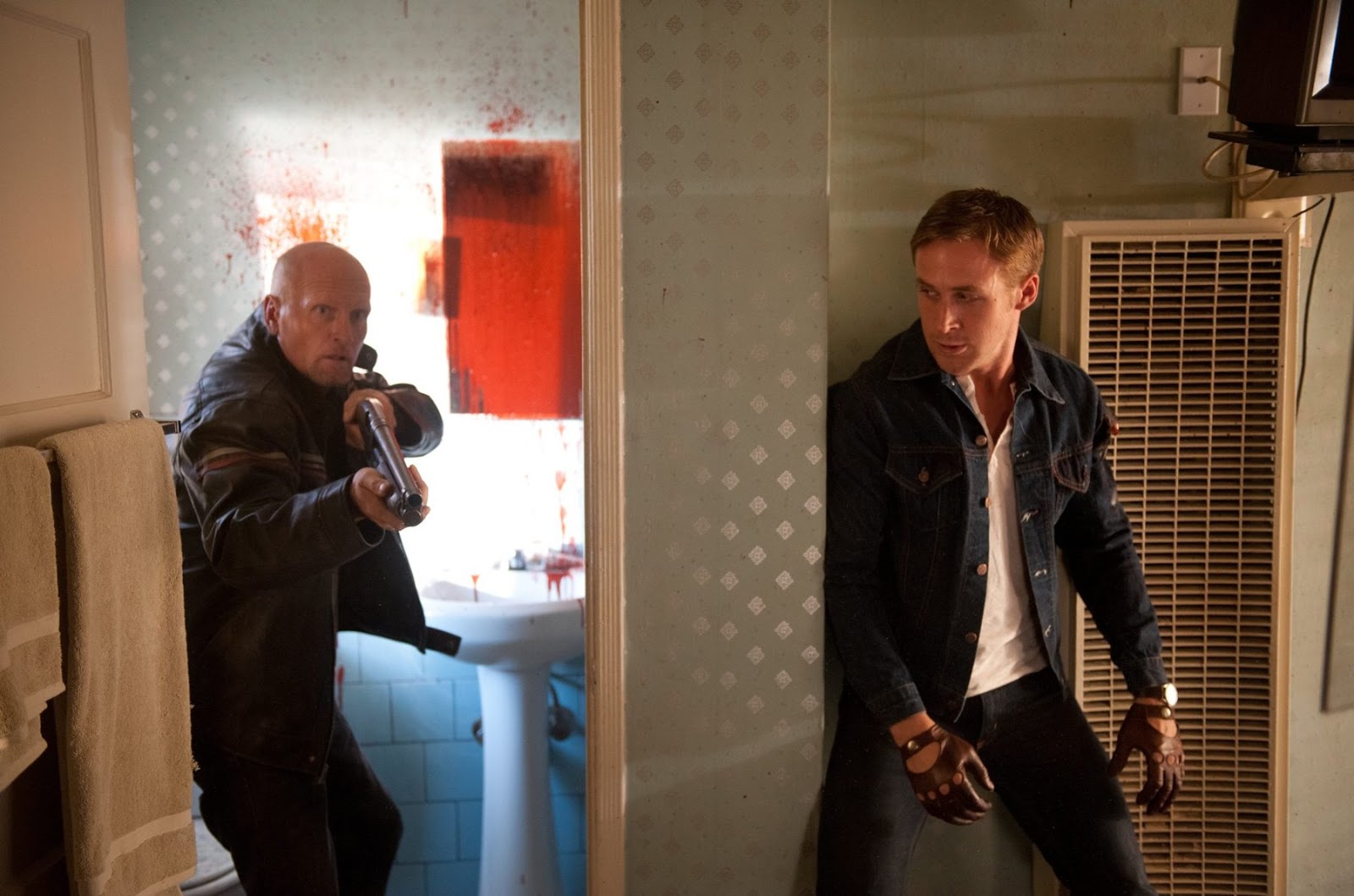
Drive review


Driver: There's a hundred-thousand streets in this city. You don't need to know the route. You give me a time and a place, I give you a five minute window. Anything happens in that five minutes and I'm yours. No matter what. Anything happens a minute either side of that and you're on your own. Do you understand? 
Director: Nicolas Winding Refn
(2011)
There is something about Drive that makes for a somewhat awkward viewing experience. Make no mistake, it’s an effortlessly stylish film, directed with such elegant precision by Nicolas Winding Refn, yet these factors don’t make for an easy watch. The cool as a cucumber 80’s vibe and mesmerising cinematography is almost unhinged by some incredibly odd encounters, as our chiselled protagonist ‘The Driver’ (Ryan Gosling) is as emotionally complex as he is socially incapable.

A stunt driver for films by day and expert getaway driver for the criminal underworld by night, The Driver exudes independence that maintains a distance between him and everyone in his life. His employer Shannon (Bryan Cranston) is a compassionate ally, even though such niceties fruitlessly rebound off of Goslings glacial 1000 yard stare. This enigma of a man opens up somewhat when he meets neighbour Irene (Carey Mulligan). The romance that is poised to blossom is abruptly interrupted by the return of Irene’s husband Standard (Oscar Isaac) fresh out of prison and a changed man. Standard owes the wrong people protection money, and in order to help Irene and son (Benicio) (Kaden Leos), The Driver opts to help him out, putting him on the wrong side of local gangsters Nino (Ron Perlman) and Bernie (Albert Brooks).


Drive is an interesting film for Winding Refn, who’s remembered for Valhalla Rising and the Pusher trilogy. It’s primarily a drama with a focus on The Drivers relationship with Irene and her son, but takes frequent forays into a multitude of other genres. The opening scene is a prime example of this, a getaway chase after a botched robbery by The Drivers clients. Despite the thrilling build-up of tension, the quick tick of a watch, the beep of the open door indicator and Goslings slight worry hidden under a face of complete coolness and control, the chase doesn’t involve loud cars and handbrake turns around corners. Instead we’re treated to something of an arthouse action scene as the driver evades patrol cars and helicopter spotlights before shaking the off the police by synchronizing the getaway with the finish of a local baseball match. There is no denying it’s is a sublime scene, but it doesn’t entertain in a conventional matter, very much setting the groundwork for the rest of the film.

Seeping from every pore of Drive is an innate coolness that is worked into every frame of the film. The Driver nonchalantly chews a toothpick for the most of the film, staring into space. Many of his encounters with other characters involve lots of silence and awkward eye contact. It’s almost a competition of sorts, who can pose in the most stylish way possible in order to make their on screen counterpart look inferior. This is largely due to a minimalistic script, in which dialogue is used as sparingly as possible. Each line is carefully chosen, almost as if he’s afraid to waste any words in a sentence. We don’t need to have Irene talk about her unhappy marriage when we can gain this information from her husband’s story about how they first met.


Augmenting the films ice cool attitude is its stellar soundtrack, a glorious sample of 80’s club techno that bursts into life at precisely the perfect moment. Its no secret the film wears it love of this bold decade for all to see-its title font for instance- but the choice of songs seem inspired. When Real Human Being fades in as the sun peaks into shot while Gosling and Mulligan drive down an abandoned storm drain, it feels like Winding Refn is in complete control; the master of his retro universe.

While Drive feels so very fresh faced in a crowd of getaway films, it occasionally stumbles when it turns to convention, a dull decision made worse by how unique the film actually is. A development in the second half makes the antagonists off screen east coast mobsters, an unseen presence that lazily drives the plot forward. This also demeans Perlman and Brook’s wonderful work as the bad guys, both of whom seem less of a threat when they themselves have their own, bigger enemies. The finale is also an issue, bordering on unsatisfying anticlimax. These factors coupled with the uneasy exchanges between characters makes the first viewing of Drive is relatively hit and miss, though this shouldn’t be a deterrent for watching the film a second time. The more times it is seen the more it can be understood, and this layered approach is partly what makes Drive on of the best films of 2011.


Thursday, 14 March 2013

The Walking Dead Season 3 Episode 12 review: Clear


!!!!!!WARNING SEASON 1 AND 3 SPOILERS!!!!!!
CLICK THE LINK TO VIEW


The Grey review


Ottway: A job at the end of the world. A salaried killer for a big petroleum company. I don't know why I did half the things I've done, but I know this is where I belong, surrounded by my own. Ex-cons, fugitives, drifters, assholes. Men unfit for mankind. 

Director: Joe Carnahan
(2012)
Whatever you think you know about The Grey needs to be forgotten instantly. Despite what the trailers want you to believe, this isn’t a film about Liam Neeson being an unstoppable badass who has a penchant for punching wolves in the face; Taken set in the wilds of Alaska if you will. Director Joe Carnahan’s latest is nothing of the sort. Instead we’re served a survival film as much about man vs. environment as it is man vs. killer wolf. Make no mistake, The Grey isn’t particularly realistic, but is redeemed by some strong core components that make for an enjoyable final product.

What instantly scuppers any preconceptions of The Grey is the opening monologue from Neesons Ottway, a letter to a loved one who he is no longer with. This written poetry is backed up with some evocative shots of the unforgiving Alaskan landscape, as smoke gently rises out of chimneys into the pitch black sky. Ottway is a wolf hunter, employed to keep the other men- of which he describes as Ex-cons, fugitives, drifters and assholes – safe. Before a plane leaves to take everybody home, Ottway puts his rifle in his mouth, intent to pull the trigger. His distressing action is stopped by the cry of a wolf in the distance, the irony not immediately apparent. He chooses to board the plane, only for it to crash in the wilderness, forcing him and 6 other survivors to fend off against a pack of deadly wolves all while searching for rescue.


What helps keep The Grey fresh through its 2 hour running time is director Joe Carnahan’s ability to successfully straddle multiple genres. The plane crash and resulting aftermath are indicative of various survival films, as the oil workers battle the elements to rescue the injured and remain as warm as possible. Within 10 minutes it’s an action flick as Ottway gets mauled by the wolves in the surrounding area. By nightfall, things shift towards horror, the wolves eyes shimmer from the abyss of darkness that surrounds our protagonists. While the survival aspects aren’t realistic enough, the action too poorly shot and the horror relatively unfrightening, Carnahan gives just the right amount of development on each. The result is a film that's far greater than the sum of its parts.

While the characters won’t be remembered for their names, the film packs a strong punch around a campfire at the midway point, as our protagonists tell each other stories to quell the fear of an impending wolf attack. Carnahan makes us care, as these broken men talk about their families and children and their longing to see them again. Such a tender moment is shattered in my head and despite its opening monologue and survival aspects, The Grey eventually boils down to a horror film; I know these people won’t make it to the end. It’s a surreal emotion, films like this are usually populated by empty stereotypes, and the last time I yearned for the entire cast of a horror film to survive to the credits was James Cameron’s Aliens.


The intensity of the survivors descent into the barren tundra is proliferated by some sound technical work; a quality blend of CGI and practical effects. The wolves are an interesting blend of animation and puppetry, courtesy of The Walking Dead’s makeup maestro Greg Nicotero. While the CG isn’t much cop, it is well hidden by shadows and snowstorms, an attempt at the ‘less is more’ approach. The puppets and models work better, the threat feels more real to a much larger degree. What's even more impressive is the strong sound design that augments the wolves’ feral and dangerous nature. Why show your audience when you can force them to hear ravenous growls hiding under the cover of darkness?

For all its strengths, The Grey is bound to be remembered for its failings. In reality, wolves aren’t nowhere near as malicious as they're portrayed here, and the harshness of the wilderness would’ve killed the survivors in hours due to their inability to look after themselves. Some dodge this by stating the wolves are a metaphor and the environment represents purgatory, but these arguments are weak when compared to how much the film does get correct in these regards. It needs to be taken with a fairly large dosage of salt, but The Grey is a fine survival drama, with Neeson at his best since Batman Begins.


Friday, 8 March 2013

The Perks of Being a Wallflower review


Charlie: I really wanna be a writer but I don't know what I'd write about. 
Sam: You can write about us. 
Patrick: Call it 'The slut and the falcon' make us solve crimes 

Director: Steven Chbosky
(2012)
2012 has been a surprisingly strong year for film. The brilliance has ranged from the explosive (The Dark Knight Rises), the clever (Looper) and the magical (Life of Pi). With such quantity in the quality of mainstream films, scores and scores of smaller, but no less entertaining films get pushed aside in cinema listings, unfairly overlooked. The Perks of Being a Wallflower is one of these films.

Perks focuses on Charlie (Logan Lerman) a troubled teenager who is about to go to a public school for the first time due to being homeschooled all his life. Through a letter for his anonymous friend he narrates his journey, offering insight to his mental condition and his feelings to how his life is unfolding. After a few days struggling being the new kid, Charlie befriends Patrick (Ezra Miller) and his half sister Sam (Emma Watson), 2 constantly quirky seniors who take him under their sheltering wing. Soon Charlie breaks free from his shell as he takes a journey to the end of his childhood that exposes who he truly is.


While Perks is most definitely a coming of age story, it’s not fuelled by adventure (the Goonies) or vast amounts of self discovery (Stand by Me). Yes, Charlie does find his place in the animal kingdom that is high school, but he adapts to fit his environment, spurred on by his need to feel normal. Despite his mental condition, Lerman makes him almost universally likable; everyone has moments of loneliness or longing while growing up. This urge to gain the respect of your peers is what Writer/Director Steven Chbosky channels constantly, a thematic choice that allows Charlie’s sometimes strange behaviour to have little impact on how relatable he is.

The trio of Lerman, Watson and Miller make up the core experience in Perks, and each is a perfect match for their characters. Watson is sublime in her first post Potter role as Sam, Charlie’s potential love interest and guide through his progression from near silent protagonist to eccentric socialite. She’s a sublime blend of dependable and seductive, although not without some serious baggage. Her brother Patrick is similar in many ways, his idiosyncratic lifestyle and warm demeanour is offset by his struggles with his hidden relationship with Brad, a fellow student with an urge to remain secret about his sexuality.


It’s in these more serious vibes that Perks suffers from its poor change in tone. One scene will consist of fun humour and engaging scenarios, only for child abuse and violent homophobia to rear their startling heads in the next. What's even more terrifying is how casually such themes are handled and the flip-flopping between styles is exceedingly uncomfortable at times. These dark moments are totally necessary, but are downplayed far too casually. The use of drugs fares much better, from a nervous Charlie eating a brownie at his first house party and getting stoned, winning him a great amount respect to doing LSD and falling asleep in the snow. Chbosky’s delicate comic touch works in the case of substance abuse but his attempts to brush other issues of so nonchalantly is detrimental to the quality of the film.

While it does tick most of the boxes of its genre, The Perks of Being a Wallflower never feels stale or derivative. There are enough jokes, relationships and chemistry between the 3 leads for the entirety of the film to work sufficiently. Chbosky’s handling of mature themes is haphazard at best and atrocious at worst, a flaw amplified considering he wrote the book the film is based upon. It may lack that powerful aura of youth that something like Stand by Me has, but that doesn’t stop Perks from being a hidden gem in a year of strong films.


Wednesday, 27 February 2013

Short review: Misery

Director: Rob Reiner
(1990)

It’s unfortunate to remark that 1990 thriller Misery is less than the sum of its parts. James Caan, Kathy Bates, directed by Rob Reiner and based on a Stephen King novel; it has the makings of a classic. Yet these components are functional rather than sensational, leaving Misery feeling slightly undercooked. Famed novelist Paul Shelton (Caan) has a car crash only to be thankfully rescued by his “number 1 fan” Annie Wilks (Bates). His injuries leave him bed ridden as Annie’s crazy obsession with him bubbles to the surface. Bates does a good job as this distressingly creepy crazed fan, although she often overdoes key moments with a little too much lunacy. This is a contrast to Caan; giving a performance so phoned in that he’s almost catatonic at times. The film is certainly disturbing; although its concept isn’t suited to the films stretched running time.


Wednesday, 20 February 2013

Moonrise Kingdom review


Sam: What happened to your hand? 
Suzy: I got hit in the mirror. 
Sam: Really? How did that happen? 
Suzy: I lost my temper at myself. 

Director: Wes Anderson
(2012)


In a way, it’s a shame just how little of Wes Andersons work I have seen. A weird and wonderful director, I was instantly drawn to his 2012 film Moonrise Kingdom due to the delightful Fantastic Mr Fox (2008). While my love for stop motion animation did factor somewhat on my enjoyment of the film, the oddball and erratic sense of humour was the true reason for my affection. With what felt like grand expectations I viewed Moonrise Kingdom, a film that’s as challenging as it is wonderful.

The story of Andersons latest is incredibly basic, lacking in any form of narrative complexities. Sam Shakusky (Jared Gilman) is the most unpopular member of the Khaki scouts, lead by the often hilarious scoutmaster Ward (Edward Norton). On the other side of the Island of New Penzance resides Suzy Bishop, a young girl with aggression issues and an affection for reading. Both are feeling stifled from their respective lives and hatch a plan to run away together as a storm approaches the island. With the help of Scoutmaster Ward, Police Captain Sharp (Bruce Willis) sets up a search party to find the youngsters before the weather ravages the island.


Staying true to form, Moonrise exhibits the same charm Anderson is renowned for. An emphasis on children, who often possess grown up tendencies, a bittersweet tone and lots of quirky situations; it’s all here. Yet in spite of this delightful front, Moonrise Kingdom feels remarkably half-hearted. It’s not as kooky as some of his other works (such as Fantastic Mr Fox) but doesn’t possess a strong core narrative to make up for the lessened charm. It makes for a bizarre film, one that equally hard to define as it is to appreciate. A fine example is Suzie’s parents, played by Bill Murray and Frances McDormand. Both of these talented actors are squandered in almost throwaway roles, their lawyer lifestyles and almost eccentric tics being severely underutilized by a director who smothers his films with such actions.

Other members of the cast aren’t squandered in the same manner however, with both Norton and Willis stealing a good few scenes. They're helped by an extravagant script from Anderson and Roman Coppola (the duo’s second collaboration after The Darjeeling Limited) consisting of some of the oddest humour you’ll ever come across in films. From electroshock therapy for orphans to fishing hook earrings, the use word bizarre would be an understatement. While the dry humour has been retained, Moonrise hasn’t been written to make its audiences sides ache, but rather to make them chuckle instead. The restrained comedy sits well with the overall tone of the film itself, which exudes a gentler, mellower feel. This is unmistakably Anderson and detractors won’t find solace in this latest outing, the humour remains as wet as any desert.


Set in 1965, Moonrise Kingdom is steeped in immersive period touches that bring this small island community to life. Augmenting this is the choice of shooting the film on 16mm, bathing scenes in a smeared, mystical hue. The format’s restrictions rears its ugly head every once in a while-especially with long shots- but Robert D. Yeoman’s cinematography is strong. While the distinguishing visuals may signal otherwise, Moonrise Kingdom is unmistakably a Wes Anderson film. The man clearly has a formula and his love for having focus on youthful characters, whether in age or spirit, is fully intact. Yet the final product feels a tad disappointing, under cooked somewhat. It’s not a bad effort, but doesn’t feel as fleshed out as one would expect from such a talented director. A film to watch and enjoy, but not to love and cherish.


Saturday, 16 February 2013

Zero Dark Thirty review


Dan: Can I be honest with you? I am bad fucking news. I'm not your friend. I'm not gonna help you. I'm gonna break you

Director: Kathryn Bigelow
(2012)
ZDT kicks off in startling fashion; a black screen reminiscent of Kubrick, the substance of the scene comes not from what we see, but what we hear. Actual audio from the September 11th attacks on the world trade centre, people screaming, crying, a devastating combination of scared and confused. For a film that charts the journey of the locating and killing Osama Bin Laden, Kathryn Bigelow (The Hurt Locker) takes the bold decision to start at the beginning. What begins is the almost 10 year hunt for the infamous perpetrator, shown through the determination and incredible will of one phenomenally dedicated woman, Maya (Jessica Chastain).

Maya’s journey begins in a detention centre in a CIA blacksite, bearing witness to the torture of Amman (Reda Kateb) a known associate of Al Qaeda. The dirty work is executed by Dan (Jason Clarke), an interrogator who becomes a close ally of Maya’s. Chastain does a wonderful job of showing Maya’s initial fragility, merely a young woman almost fresh out of high school. Dan’s interrogation is successful, giving Maya the name of Abu Ahmed. We follow Maya through her hunt for leads to Bin Laden, a mission she dedicates her life to.

As an audience, we all know how ZDT will end; the conclusion is ingrained in the memory of anyone old enough to remember the horror of 9/11. But the success of Bigelow and Hurt Locker writer Mark Boal is how this conclusion is reached, a strong emphasis on plot over story. Much like her previous film, ZDT can’t be stuffed into a genre like many films; instead it exists in many, ranging from drama to action. The opening, torture focused act makes way for the meat and potatoes of the film, almost an investigative thriller, not to mention a character study of Maya. Its engrossing stuff, riveting to the point of making the spurts of action almost seem dull.


Calling Chastain’s Maya the beating heart of ZDT would be a slightly misleading statement. Once again she steals scenes effortlessly, something she has done in everything appearance from The Tree of Life to Lawless. The talent of the actress isn’t in question here but instead the depth of her character. Maya is a machine, dedicating most of her life to hunting down terrorists. She’s cold, calculating and merciless; one dimensional up until the film’s sensational final shot. Strong female protagonist she might be, but she isn’t a complex one. This is somewhat bizarre, especially considering how brutal torturer Dan has his emotional frailties and intricacies. The fact Maya is based on an actual real life person (or persons) is ever so slightly terrifying.

For the most part Boal's dialogue is gripping and exciting, guiding the audience through the relatively complex plot without resorting to patronising handholding. Yet it has the occasional lapse, moments when he gives talented actors monumentally ridiculous things to say. It’s unfortunate that Chastain’s Maya takes the brunt of the flak, spouting shit such as (“I'm the motherfucker that found this place, sir.”), harmfully stripping away the seriousness of the films events up to this point. These slips into the outlandish aside, Boal has succeeded admirably.


Bigelow shifts gears once again in the final 3rd, a startlingly accurate of SEAL Team 6’s raid on Bin Laden’s compound. It’s almost shot in real time, minute for minute. The ferocity of doors being breached and the vicious sound of bullets as they tear through the air are impressive, the lack of music amplifying the quality of the sound design, as well as perfectly setting the atmosphere. It’s entertaining, but never cinematic, Bigelow has puts more emphasis on crafting an accurate portrayal rather than an engrossing action scene. While this is admirable, taking some artistic licence with such a pivotal moment would have worked wonders.

 Taking into consideration the subject matter, Bigelow has succeeds admirably with Zero Dark Thirty. We all knew what the outcome of this 2 and a half hour film would be, but the way this conclusion is reached is engrossing. A fine example of how an excellent plot can infuse life in even the most well known stories.


Monday, 11 February 2013

Martha Marcy May Marlene review


Patrick: You know that death is the most beautiful part of life, right? Death is beautiful because we all fear death. And fear is the most amazing emotion of all because it creates complete awareness. It brings you to now, and it makes you truly present. And when you're truly present, that's nirvana. That's pure love. So death is pure love. 


Director: Sean Durkin
(2012)
2012 seems like an incredibly clustered year for films based on cults and organised religion. Most notably is P.T Andersons The Master, a powerful, intimate epic shot in razor sharp 70mm and featuring peerless performances from Joaquin Phoenix and Phillip Seymour Hoffman. Even less renowned on the arthouse scene was Sound of My Voice, a smart and open ended drama about a cult leader who claims to have travelled back from the future. Martha Marcy May Marlene is so similar to the afore mentioned titles for a multitude of reasons. Yes, it features a ‘cult’-all 3 of them do- but they never feel similar enough to draw serious comparisons when it comes down to themes and narrative. They're all alike for 3 reasons; strong performances from their leads, multilayered and leaving the hard work up to the audience and possessing conclusions that absolutely divide audiences straight down the middle. Make no mistake; Martha Marcy May Marlene isn’t an instantly gratifying Hollywood blockbuster.

Despite insinuating 4 characters, the names in the title of the film are technically all the same person. We open with Martha (Elizabeth Olsen), a young women who has escaped the clutches of an abusive cult. Her escape is aided by her unknowing sister Lucy (Sarah Paulson) and fiancĂ© Ted (Hugh Dancy). As she struggles to regain a foothold into everyday life, we are shown flashbacks to her inception into the cult; a quaint farm in New York State. It’s in these flashbacks she is known as Marcy May, a new name given to her by the leader of the group Patrick (John Hawkes). Marlene is the name she adopts when answering the phone. Through thoughtful, fragmented editing we see her life, as well as the effects her past have had on her mental wellbeing.


MMMM is helped tremendously by some subtle, yet sublime camerawork by Jody Lee Lipes. Extreme close-ups capture the emotional crescendos of confrontation; the decision to focus almost exclusively on the face of the characters is a good one. Long takes are prevalent throughout; slow, strained zooms amplify the drama and intensities of the majority of the scenes. While this technique significantly adds to the films dark, uncomfortable themes, it becomes overused by the third act; so much so the trick loses its effectiveness.

Yet what remains constant throughout this unsettling look at cults is the performance of Elizabeth Olsen. An up and coming star, she owns the role of both Martha and Marcy May, her name while she lived with the cult. The films use of jump cuts makes her work seem so much more prominent, the emotional damage that she portrays after escaping the group is shown in its full effect. The spontaneous confident girl has her innocence warped by her experiences, making her very much 2 sides of the same coin. Essentially, Olsen is playing 2 rather different characters both of which she embodies superbly; quite simply one of the best performances of the year.


The acting prowess doesn’t cease there however, as MMMM is filled with strong, realistic performances. Just how successful these actors are isn’t initially realised, their roles don’t call for eccentricities or long, impressive speeches. Instead each character is grounded, complimenting the serious tone of the narrative. This decision is what makes Antagonist Patrick so terrifying. His lies and indoctrinations sound so true, it’s easy to understand why this group of women fall for the game that he’s selling. Just how sinister he really is isn’t fully shown, but merely hinted at with scraps of dialogue littered throughout the flashbacks, another factor that adds to his unsettling menace.

After 90 minutes of Olsen’s mesmerising performance, some strong camerawork and a dark, disturbing plot, Durkin ends his film is an incredibly unsatisfying manner. Ambiguity is a wonderful thing when correctly used, yet such technique isn’t present here. While it does fit thematically, the final shot feels abrupt and frustrating, sucking the soul out of a film that had up until this point been excellent. In retrospect this conclusion hits all the right notes, yet will cause many audience members to scratch their heads in confusion. Martha Marcy May Marlene is a great debut feature for Sean Durkin, but because of the lack of payoff in the third act, I doubt it will be a popular one.