Showing posts with label Action. Show all posts

Thursday, 25 April 2013

Iron Man 3 review


Tony Stark: You're not a man. You're nothing more than a maniac. I'm not afraid of you. No politics here: just good old fashioned revenge.
Director: Shane Black
(2013)
Regardless of the quality of the content, Marvels Phase One was a resounding commercial success. Initialised by Ironman (2008) and concluded by the spectacular yet hollow The Avengers, the 6 film series made 3.8 billion dollars across the world, Phase 2 was going to be a thing regardless of what anyone thought. In a move reminiscent of the start of the Marvel Cinematic Universe, this next chapter also begins with another Ironman film with Robert Downey Junior reprising his role as the genius billionaire playboy philanthropist. While there’s little doubt that box office receipts will reach hundreds of millions, it’s a crying shame that Ironman 3 isn’t the experience we were all hoping for.

After the events of The Avengers, Tony Stark is in a dark place. Racked with insomnia and suffering severe anxiety attacks, he spends most of his time tinkering with his creations. His obsession pushes the boundaries of girlfriend Pepper Potts (Gwyneth Paltrow) who is intent on leaving him. When Tony becomes embroiled with terrorist The Mandarin (Ben Kingsley), he is left isolated and alone, struggling to protect those he loves and cares for. With the help of James Rhodes (Don Cheadle) he sets out to stop The Mandarin while getting caught up in a biological project run by Aldrich Killian (Guy Pearce) known as ‘Extremis’.


The films biggest issue resides with its story, a dismal blend of underdeveloped arcs and telegraphed revelations. The vast majority of the films plot is given away in the film’s opening flashback, forcing us to wait for Stark to play catch-up for another 30 minutes before events can progress any further. Killian’s motives are weak, Guy Pearce’s best efforts simply can conceal how much a generic villain he truly is. What’s mishandled even more is both The Mandarin and the Extremis plot arc. Kingsley’s villain is an intimidating, fearful character to begin with, his untraceable terrorist attacks and TV hijackings paint him as a more cerebral man than an outright violent one. But soon he is nothing more than Osama Bin Laden minus a turban, committing televised crimes like a cheap Joker impersonator. Soon focus shifts away from Kingsley’s hard work back to Killian, making the film suffer dramatically with a terribly implemented plot twist.

Where the film also falters is in the action scenes, which strive to be functional instead of exciting. The climax to The Avengers would be difficult to top, so Black smartly sidesteps the issue, giving us a large scale conflict that is small enough to remain personal. While it’s initially a joy to see dozens of Ironman suits jetting through the sky, it soon becomes apparent that all we’re really witnessing is bright lights and searing explosions, the decision to shoot the finale in darkness (again) results in some muddled visuals by the folks over at Weta Digital. Instead of emphasising the unique roles of these additional suits, they’re instead used as cannon fodder for extremis aggressors, appearing in frame only to be obliterated just moments later.


Elsewhere the quality of the action is even more temperamental, sometimes beautiful but mostly messy thanks to some tight camerawork and choppy editing. The destruction of Starks house is a prime example of this, the personal devastation of the attack is lost in a sea of loud noises and smeary rubble. The second act set piece involving Starks rescue of passengers from a destroyed plane is more engrossing, primarily thanks to the fact that it was shot by an aerial stunt team.

Extremis is even worse, a facet of the plot that is wholly uninteresting and incredibly simplified, acting as nothing more than a way to avoid having Ironman fight more robotic foes after the suit heavy battles of the first 2 films. The result is a massive waste of Rebecca Hall’s talent, her part in the film is reduced to sexy scientist who spells out the plot for those incapable of putting 2 and together. In fact, it seems there was no point in casting Kingsley, Pearce or Hall outside of a handful of scenes, squandering potential seems to be what Ironman 3 does best.

Of course, these disappointments are alleviated slightly by Downey Junior’s Stark, a role that he wears like a second set of skin. While his comedic timing remains impeccable, the character’s humorous side is toned down significantly, a result of the PTSD that he suffered due to the climax of The Avengers. This additional depth to the character is a welcome one, seeing his massive ego reduced to nothing is a welcoming and strangely affecting, and portraying the fallibility of seemingly indestructible superheroes is the step in the right direction for the Marvel Cinematic universe as a whole. Yet beyond Starks advances, Ironman 3 is a severely unsatisfying experience, marred by a bad story and soulless action. The conclusion is limp, a defect that extends to the now famous after credits sequence which isn’t worth waiting for. Spending too much time reflecting on Phase One instead of paving new ground, this is undoubtedly the first big disappointment of the year. We can only pray that isn’t indicative of things to come.


Saturday, 13 April 2013

Short review: Alien 3

Director: David Fincher
(1992)

Even without prior knowledge, it’s easy to see that Alien 3 had suffered terribly during development. David Fincher’s directorial debut was unfairly ruined by an idiotic and interfering studio; the result is a weak link in a potentially brilliant trilogy. By killing off Newt and Hicks just minutes in, Alien 3 sours the taste in the mouth of fans of Aliens, and things don’t improve much from there. The writing and editing is all over the shop with a largely uninteresting plot and characters that disappear with no explanation. The film manages to be hideously boring at times too, rescued by some stellar art and set design that is amongst the series high points. Looking beyond the excitingly impractical climax, Alien 3 lacks the horror and suspense of the original film and the visceral gunplay of its sequel. The result? A total mess.


Friday, 22 March 2013

The Dark Knight review


The Joker: It's simple, we kill the Batman. 

Director: Christopher Nolan
(2008)
Over 4 years on, it’s easy step back and observe the effect that The Dark Knight has had on the superhero genre, as well as films on the whole. When one thinks of comic book adaptations, crappy effects, shoddy dialogue and men in ridiculous rubber suits all unfortunately spring to mind. But Christopher Nolan has changed such a trite genre for the better. After sowing the seeds of change with 2005’s Batman Begins, he blossoms this hard work into a truly fine effort, the genre transcending blockbuster that is The Dark Knight.

18 months after Batman Begins, Gotham is becoming cleaner, criminals fear the night and thanks to The Batman (Christian Bale) the city is relatively safe. Through the combined efforts of The Dark Knight, Lt Gordon (Gary Oldman) and district attorney Harvey Dent (Aaron Eckhart), mob bosses are slowly losing their grip on the underworld. Things change dramatically with the arrival of The Joker (Heath Ledger), an insane and formidable adversary, hell bent on bringing Gotham and Batman to their knees. As the Jokers mania spreads, Bruce Wayne must push his alter ego to the very limit in order to protect those closest to him, namely butler Alfred (the always sublime Michael Caine) and attorney Rachel Dawes (Maggie Gyllenhaal, replacing Katie Holmes).


If fear was the central theme of Batman Begins, then The Dark Knight is fuelled by unpredictable Chaos, a tone that Nolan sets from the get go. A 6 man bank heist is orchestrated, complete with a multitude of double crosses and the reveal of our scene stealing antagonist. From this stunning scene on, Nolan doesn’t let up. Explosions, chases, brawls and city wide pandemonium act as the fuel to a mesmerising film which pushes its genre, and filmmaking in general into bold new territory. This is in equal parts due to the dark, gritty tone, shooting key scenes in the ultra sharp IMAX format and The Joker himself, excellently portrayed by the late, great Heath Ledger.

While Batman Begins was no slouch in the acting department thanks to a strong assemble of talent, the performance that will be remembered for years to come is Batman’s most infamous foe. Ledger knocks it out of the park as the psychotic clown, his excellent dialogue delivered in such a zany, mesmerising manner that we almost forget that the caped crusader is indeed the star of the film. Ledger’s career has been a fine one, but this is what he’ll be rightfully remembered for.


The dark knight marks the start of a new phase of Nolan films, no longer restricted by budget; he is able to craft his film to fit his vision. Going against the grain when it comes to superhero films, the use of CGI here is kept to a minimal, with practical effects being used as often as possible. So when a bus crashes through a wall, a truck gets flipped on its head or a car gets destroyed, we’re seeing it actually happen. Such a practical approach is even used in bigger situations, the Jokers demolition of Gotham hospital is done for real, right down to the roof crumbling to the floor.

Taking an almost Spielbergian approach to set pieces, Nolan once again defies modern convention by showing us as much of the action as possible. The camera doesn’t shake around violently but remains smooth, framing the action so we as an audience can digest each punch and explosion. The editing is sound in this respect too, scenes are relatively long; nothing gets shredded into incomprehensible blur like other, lesser offerings. For the most part this works wonderfully, but there are moments when this directorial choice is a detriment to the overall quality of the film. Take Batman himself, dishing out hefty blows to Gotham’s criminals and the Jokers goons. It looks realistic, but the slow nature of Bales movement makes him appear sluggish in his brawls. It’s not a monumental issue, but it paints the caped crusader as a lumbering brute rather than the agile ninja that he truly is.


There is little doubt that The Dark Knight is a masterstroke in filming, a delicious concoction of old school philosophies and convention obliterating plot twists. But like all of Nolan's films, even those seemingly designed to be watched more than once (Inception), the film doesn’t lend itself well to multiple viewings. If The Dark Knight is watched once, and only once, it’s a 10/10 film in every regard. Viewing it a second time is a lessened experience however, and the narrative creaks under its gargantuan weight. Both Two Faces rampage and the ferry sequence seem rushed and implausible. It’s still a terrific film, but the magic it generates when viewing for the first time is an unrepeatable feeling. Regardless, this is bound to go down as Nolan's masterpiece, the great second act in a genre redefining trilogy.


Thursday, 14 March 2013

The Grey review


Ottway: A job at the end of the world. A salaried killer for a big petroleum company. I don't know why I did half the things I've done, but I know this is where I belong, surrounded by my own. Ex-cons, fugitives, drifters, assholes. Men unfit for mankind. 

Director: Joe Carnahan
(2012)
Whatever you think you know about The Grey needs to be forgotten instantly. Despite what the trailers want you to believe, this isn’t a film about Liam Neeson being an unstoppable badass who has a penchant for punching wolves in the face; Taken set in the wilds of Alaska if you will. Director Joe Carnahan’s latest is nothing of the sort. Instead we’re served a survival film as much about man vs. environment as it is man vs. killer wolf. Make no mistake, The Grey isn’t particularly realistic, but is redeemed by some strong core components that make for an enjoyable final product.

What instantly scuppers any preconceptions of The Grey is the opening monologue from Neesons Ottway, a letter to a loved one who he is no longer with. This written poetry is backed up with some evocative shots of the unforgiving Alaskan landscape, as smoke gently rises out of chimneys into the pitch black sky. Ottway is a wolf hunter, employed to keep the other men- of which he describes as Ex-cons, fugitives, drifters and assholes – safe. Before a plane leaves to take everybody home, Ottway puts his rifle in his mouth, intent to pull the trigger. His distressing action is stopped by the cry of a wolf in the distance, the irony not immediately apparent. He chooses to board the plane, only for it to crash in the wilderness, forcing him and 6 other survivors to fend off against a pack of deadly wolves all while searching for rescue.


What helps keep The Grey fresh through its 2 hour running time is director Joe Carnahan’s ability to successfully straddle multiple genres. The plane crash and resulting aftermath are indicative of various survival films, as the oil workers battle the elements to rescue the injured and remain as warm as possible. Within 10 minutes it’s an action flick as Ottway gets mauled by the wolves in the surrounding area. By nightfall, things shift towards horror, the wolves eyes shimmer from the abyss of darkness that surrounds our protagonists. While the survival aspects aren’t realistic enough, the action too poorly shot and the horror relatively unfrightening, Carnahan gives just the right amount of development on each. The result is a film that's far greater than the sum of its parts.

While the characters won’t be remembered for their names, the film packs a strong punch around a campfire at the midway point, as our protagonists tell each other stories to quell the fear of an impending wolf attack. Carnahan makes us care, as these broken men talk about their families and children and their longing to see them again. Such a tender moment is shattered in my head and despite its opening monologue and survival aspects, The Grey eventually boils down to a horror film; I know these people won’t make it to the end. It’s a surreal emotion, films like this are usually populated by empty stereotypes, and the last time I yearned for the entire cast of a horror film to survive to the credits was James Cameron’s Aliens.


The intensity of the survivors descent into the barren tundra is proliferated by some sound technical work; a quality blend of CGI and practical effects. The wolves are an interesting blend of animation and puppetry, courtesy of The Walking Dead’s makeup maestro Greg Nicotero. While the CG isn’t much cop, it is well hidden by shadows and snowstorms, an attempt at the ‘less is more’ approach. The puppets and models work better, the threat feels more real to a much larger degree. What's even more impressive is the strong sound design that augments the wolves’ feral and dangerous nature. Why show your audience when you can force them to hear ravenous growls hiding under the cover of darkness?

For all its strengths, The Grey is bound to be remembered for its failings. In reality, wolves aren’t nowhere near as malicious as they're portrayed here, and the harshness of the wilderness would’ve killed the survivors in hours due to their inability to look after themselves. Some dodge this by stating the wolves are a metaphor and the environment represents purgatory, but these arguments are weak when compared to how much the film does get correct in these regards. It needs to be taken with a fairly large dosage of salt, but The Grey is a fine survival drama, with Neeson at his best since Batman Begins.


Friday, 1 March 2013

Short review: Safe

Director: Boaz Yakin
(2012)

Writer/director Boaz Yakin brings us Safe, yet another generic action flick starring Jason Statham. He’s a homeless ex cop whose life gains purpose after he saves 11 year old genius Mei, whose memory holds a very important code to a money filled vault. The story here is childishly basic, yet Yakin convolutes events to give the appearance of depth and intricacy. Regardless, the Chinese, Russians and corrupt NYPD officers battle it out for the code that Mei possesses. It’s very cliché, acting almost as filler until we stumble onto the next action sequence, of which there is a plentiful supply. Some of these are practically shot and interesting, the Russian kidnapping scene for example. Yet the majority descend into sharp edits and trite camerawork, both of which render the action incomprehensible. The climactic shootout is erratic yet immensely dull, summing up the entire film rather neatly.


Tuesday, 26 February 2013

Batman Begins review


Henri Ducard: No, no, no. A vigilante is just a man lost in the scramble for his own gratification. He can be destroyed, or locked up. But if you make yourself more than just a man, if you devote yourself to an ideal, and if they can't stop you, then you become something else entirely. 
Bruce Wayne: Which is? 
Henri Ducard: A legend, Mr. Wayne. 

Director: Christopher Nolan
(2005)
Batman Begins is one of those films that is far better than it should be. On paper it’s a recipe for disaster, a talented yet relatively unknown director working with a huge budget for the first time to create a film about Batman. After the mess that was Batman and Robin, everyone was sure the caped crusader would never star in a half decent Hollywood production ever again. Yet seemingly out of the blue comes Batman Begins, the first in director Christopher Nolan's Dark Knight trilogy and hands down the best superhero origin story ever made.

What's most surprising about Batman Begins is how Nolan has taken what we think we know about the character and moulded it into a fresher, more organic form. Gone are the ridiculous gadgets, corny lines and lazy attempts at comedy; all thrown away to make room for a more serious Batman. This is an origin story, so we don’t even start with our titular hero, but instead with Bruce Wayne (Christian Bale). Holed up half way around the world beating criminals while in the confines of a jail, he meets the enigmatic Henri Ducard (Liam Neeson). Ducard offers him training with the League of Shadows, a ground of vigilantes and assassins. Through flashbacks we learn of Bruce’s childhood and relationship with Rachel Dawes (Katie Holmes), his parent’s demise and his phobia of bats. Soon Bruce returns to Gotham to take power from Carmine Falcone (Tom Wilkinson) the mob boss who has a chokehold on the city.


Nolan's Batman works because of this extensive backstory and a lengthy portion of screentime is used to fully flesh out the man behind the cowl. The first half of the film is Bruce Wayne’s story, a choice that certainly pays dividends to this legendary character. By developing Bruce this extensively, Nolan has managed to make us truly care for Batman. The strength of this strong script is proliferated by Bales ace performance, quite easily the best representation of Bruce that has ever been committed to celluloid. The importance of well written characters extends to the whole cast too, a keep emphasis from Nolan seems to be bringing DC’s most famed universe alive. Bruce’s loyal butler Alfred (Michael Caine) gives the film a touch of comic relief, his wise observations and wisecracks are worked excellently by veteran actor Caine. The same applies to Wayne Enterprises employee Lucius Fox (Morgan Freeman) the genius behind Batman’s technologically advanced gear. While these roles may appear relatively minor in the grand scale of things, they nonetheless feel deep enough to augment Bruce- and therefore Batman- as a character.

While the primary focus of Batman Begins is on character and plot development, the action sequences are never neglected in favour of more drama. For the most part Batman’s brawls are shot and edited sharply, a clever trick to give the impression of his incredible speed and ability. While some fights descend into a blur of thugs falling to the ground, we’ve invested so much into the character that the messy editing doesn’t negate to severely from any enjoyment the film radiates. No such issues persist with the vehicle scenes though, which are blisteringly fast and exciting. With the newest iteration of the Batmobile (in this case named the ‘tumbler’) the film delivers an immense payoff with a chase through the streets of Gotham. Evasions, pile ups and stunts that rip the tiles off of roofs, Cinematographer Wally Pfister certainly knows how to craft an engaging, exhilarating scene.


While Batman Begins is a grounded film, it’s by no means completely immersed in realism. Villains and their usually absurd powers are either dropped or backed up by some vague yet consistent science. Batman’s cape allows him to glide by passes electric currents through it and the Tumbler has a rocket booster attached to the back. Yet because the narrative isn’t silly, these oddities can be overlooked at no expense of the films quality or how enjoyable it is. Even secondary villain Scarecrow (Cillian Murphy) has his reasons; the tattered mask is to intimidate his patients, an accessory that compliments his mind shredding fear gas.

For its strong writing from David S. Goyer and Jonathan and Chris Nolan, Begins does have its moments of audience patronising handholding. Close to the films stellar climax, exposition is lathered on not once but twice, both of which feel slightly unneeded. Still, it’s easy to poke holes in such minor issues when the rest of the film gets everything so very right. Batman Begins is the film that gave the world a fantastic new director and the rebirth of one of the world’s most famous superheroes. In this context, it’s unmissable.


Friday, 8 February 2013

Short review: John Carter

Director: Andrew Stanton
(2012)

In retrospect, it’s easy to see where Andrew Stanton’s John Carter went wrong. The budget was huge, the trailers drab and the name was totally unappealing. Yet even after the box office dust (or lack of) has settled, it’s become even more apparent that it’s simply a subpar film. Our titular hero John Carter (Taylor Kitsch) gets teleported to mars from civil war America and gets caught up in a Martian conflict while he tries to get back to earth. Despite a colossal budget and John’s ability to jump higher and throw farther (due to the different atmosphere) the action scenes are sorely lacking in both quality and quantity. Warships explode and soldiers die, but it’s all so very dull. The bloated running time, poor story, mediocre performances and special effects put the nails in the coffin of this underwhelming, muddled mess.

4

Tuesday, 22 January 2013

Gangster Squad review


Sgt. Jerry Wooters: Well ya gotta die of somethin'. 

Director: Ruben Fleischer
(2013)
I’ll admit, I'm a sucker for films like Gangster Squad. Much to the delight of the studio, I'm drawn into watching such a film when the cast is star studded and story is based around true events. It’s an understandable weakness, Emma Stone, Josh Brolin, Sean Penn, Giovanni Ribisi, and Ryan Gosling. With actors of such impressive calibre what could possibly go wrong? As it turns out, a whole lot.

Gangster Squad kicks off in the most worrisome way; via monologue. While a director like Alexander Payne or Terrence Malick would use such a device to smoothly set the groundwork for the narrative or characters, Ruben Fleischer (Zombieland, 30 Minutes or Less) has primary protagonist John O’Mara (Josh Brolin) talk about badges. The irony of the situation isn’t fully comprehended until later, when he forms a group of elite, gangster fighting cops who don’t actually carry said badges. This team, the ‘Gangster Squad’ of the title are formed by Chief Parker (Nick Nolte) to set in motion the downfall of notorious gangster Mickey Cohen (Sean Penn), a mob boss who’s criminal activities are bringing the west coast to its knees.


Unlike most films that owe themselves to the provocative timeframe that is the the 1940’s, the protagonists don’t fight Cohen with police warrants and detective like sleuthing, that would require a subtlety that both script and director simply don’t possess. Fleischer would much rather blow shit up, and he wastes little time in the assembling of his team of terrors. Up until this point only O’Mara and Jerry Wooters (Ryan Gosling) have any form of development or noteworthy appearance. In many ways this is a positive choice, as Gangster squad functions as a rough and ready action film far more than it does a drama, which undoubtedly feels like is been tacked on at the last minute in order to give the false impression of depth.

The action is passable though, despite lacking any form or originality. Each member of the squad possesses a certain skill, brawler, gunslinger, gadget expert etc that, while horrendously unoriginal, adds spice to the shootouts and car chases. Fleischer doesn’t skimp on said scenes which he excellently places in amongst the beat downs and downtime. The outcome of these set pieces is almost always predictable, but they do a fine job of maintaining a firm grip on the audience’s attention. Its engaging stuff, but anyone hoping for scenes akin to The Dark Knight Rises or The Raid won’t find anything of the sort here.


It’s a shame that Fleischer relies on clichés so often when characters guns aren’t blazing. This is most notable with our antagonist Mickey Cohen, a badly scripted stereotype of a character. Sean Penn is a phenomenal actor, but here he’s far more interested with wearing a perpetual sneer and growling with a laughable, animalistic tone. It’s a shoddy performance, although the script doesn’t give him much to go on considering the most complex action our villain does is scorn at as many people as possible. These laughable aspects of Gangster Squad are situated throughout the script, often tarnishing the atmosphere and tension during critical moments of the plot. during the climactic shootout in a hotel lobby, Penn pulls a face akin to a duck chewing on a lemon, loads a Tommy gun, screams “say hello to Santi Clause!” and engages in a slow motion shootout which includes dozens of presents and baubles shattering under the impact of hot lead. Its utterly ridiculous, one example of some of the abhorrent writing that makes up the majority of the final product.

Gangster squad is a rough and ready film, punctuated by brutal action and Ryan Gosling reaching into his bottomless pit of charisma. The script is dire, story development is often overlooked in favour of another witty one liner and its use of monologuing is atrocious. Yet those who choose to view Gangster Squad will get exactly what’s on the tin; a stupid yet stupidly entertaining action flick masquerading as a slick period thriller.


Monday, 24 December 2012

The Hunger Games review


Katniss Everdeen: May the odds be ever in your favor. 

Director: Gary Ross
(2012)
Films that are adapted from popular novels always face certain challenges when they hit cinema screens. Fans must be catered to, there's nothing worse than the target audience of said adaptation feeling screwed over. Conversely, appeal to general moviegoers is essential in order to be a big enough box office success to warrant a sequel. For the most part, The Hunger Games has the necessary elements to both camps, and is an involving, entertaining picture for the masses.

Set in a dystopian future of Panem, a broken America that has survived the ravages of war after an uprising against the tyrannical Capitol has failed. In order to intimidate the 12 districts that remain in Panem, the Capitol hosts an event called ‘The Hunger Games’. This yearly event takes 1 boy and 1 girl from each district and forces them to fight to the death until only one remains. After her sister gets selected for the games, our heroine Katniss Everdeen volunteers herself to be entered in order to save her younger sibling.

Right off the bat its clear that director Gary Ross is happy to show us the broken squalor that Katniss has to suffer in her impoverished home in district 12. People live in huts and shacks, scavenge food and wash in tubs. When Katniss sneaks out of bounds to hunt for food the electric fence that barricades her in is without power, yet another sign that they struggle to survive each day. It’s strong stuff, and once we’re whisked off to the Capitol at the end of the opening 3rd, the juxtaposition is a vast one. The emerald greens and thick browns are contrasted with clean whites and pastel shades that resonate from the quirky clothing of the Capitols residents. In terms of crafting a believable and interesting world, Ross is wholly successful.


While the concept of last-man-standing-deathmatch-with-kids isn’t the freshest idea in the world, The Hunger Games succeeds where others fail for a multitude of reasons. Firstly, we have some strong build-up before the games actually start; allowing Katniss to the get the character development required to be a likeable and fully fleshed out character. We also meet the other tributes and get some backstory on them, adding some small meaning to events that unfold in the arena. This can be accredited to both the strong script from Ross, Suzanne Collins (also the author of the novel) and Billy as well as Jennifer Lawrence’s excellent performance. Every emotion is cast on her face; every action feels grounded and real. She’s the driving force for a good portion of the film, due to her isolation inside the arena. It’s undeniable that with a lesser talent as the lead, The Hunger Games would simply be a weaker film.


After an interesting build up involving mentor Haymitch (Woody Harrelson) Presenter Caesar Flickerman (Stanley Tucci) and Gameswoman Effie Trinket (Elizabeth Banks), Katniss, fellow district 12 competitor Peeta (Josh Hutcherson) and the remaining children are thrown into the arena in a breathless sequence of violence and death. At least, that what I think happens, as Ross’ choice to violently jerk the camera around is crude and often incomprehensible. It’s an understandable decision (to keep the certificate at a fan friendly 12A) yet is ruins action scenes almost outright. What's worse is this erratic cinematography is used constantly in order to give a sense of first person perspective for the audience. When the camera is restless in filming 2 people conversing at a table, it’s clear that the execution of this style was horrendous. The total lack of technical proficiency doesn’t end there, and the editing is also unnecessarily choppy, with shots that don’t mesh together with any impression of cohesion.  ILM’s CGI work is also slack, with muddy textures and animals that merrily skip through the uncanny valley. Considering the 78 million dollar budget, The Hunger Games has a rough and sloppy feel to it.

The Games themselves make up the latter half of the film and are made all the more interesting thanks to the great work that adds weight to the demise of many of the characters. While half of the 24 tributes lack dialogue, the others get some semblance of development, and this causes the vicious murders to have a far greater impact. Some tributes form temporary alliances, teaming up to prey on the weak. Others work alone, staying alive thanks to honed survival skills or just pure luck. The potential monotony of the forest environment is alleviated by cuts to the control room, where the arena is modified to make the Games more exciting, and to Tucci’s commentator, used to inform the audience of events that are mysteries even to Katniss. Both break the films 1st person perspective, but don’t feel tacked on and add to the overall desperation of Katniss’ situation.


Yet despite said imperfections, The Hunger games is something that is still quite rare in today’s age of cinema; a film aimed at young adults that doesn’t pander solely to its audience. The result is an enjoyable, entertaining feature that is accessible to a wide variety of audiences. It will also do wonders for Lawrence; undoubtedly one of the stars of tomorrow.


Sunday, 9 December 2012

The Adventures of Tintin: The Secret of the Unicorn review


Tintin: There's a clue to another treasure. How's your thirst for adventure, Captain? 
Captain Haddock: Unquenchable, Tintin. 

Directors: Steven Spielberg and Peter Jackson
(2011)
With Pixar failing to make a good film in 2011 and DreamWorks punching below their weight (again), masterful director Steven Spielberg has stepped up and delivered what could well be my favourite animation of the year, The Adventures of Tintin: The Secret of the Unicorn.

Based on 3 of the original comics by Herge, Spielberg, Peter Jackson and their trio of writers and avid Tintin fans (Edgar Wright, Joe Cornish and Steven Moffat) has seamlessly blended these stories into one coherent narrative. After purchasing a model ship, our titular hero Tintin is pursued by the mysterious, yet threatening Sakharine (Daniel Craig). He teams up with Captain Haddock (Andy Serkis) to track down the clues to a long lost treasure. It’s not a particularly original or memorable story, but neither was Raiders of the Lost Ark. Its most definitely typical Spielberg, it’s all about the adventure and excitement of the journey between A to B rather than what the final destination actually is. In fact, it's a great deal like Raiders, only with gorgeous motion capture animation instead of dusty tombs and Harrison Ford.


And by gorgeous, I mean stunning, awe inspiring, face meltingly (see what I did there?) gorgeous. Textures are brimming with detail, sand and water effects are beautiful and the actual animation is lifelike. While motion capture technology has had its fair share of ups and downs (most notably characters with the cursed ‘dead eye’) Spielberg and Jackson have used it to what currently seems like its fullest potential. The performances are good too, with every actor donning the ball suits doing a solid job. Many don’t class motion capture as ‘true animation’,  and consider it cheating when live action performances are converted to digital characters, but when the results are as astounding as this, they really shouldn’t care as much as they do.

The highlight of Tintin is easily the delightful action scenes. Sword fights, shootouts and chases, Tintin is jammed full of action. The highlight, a motorbike chase through a desert city is done in one continuous take. The camera snakes through buildings and streets, effortlessly switching between different characters on the fly as explosions erupt and buildings crumble. Yet despite their visual splendour and ferocious tempo, the pacing of these scenes is poor. It takes almost half of the film until we get one of the great action scenes. Once the action does start, it doesn’t really stop, and at times it’s like Spielberg is trying to drown us in fights and the films climax suffers because it happens incredibly close to the aforementioned motorbike chase. There’s little to break these scenes up, and despite the climax being sensational, it feels like it overstays its welcome due to the lack of downtime beforehand.


The first 30 minutes also exhibit problems and are a little too focused on making events very black and white. Tintin constantly speaks to himself pointing out various, and obvious plot points. It’s as if Spielberg and Jackson don’t think we’ll understand the content in these scenes, despite the simple story and perfect camerawork that frames every detail. We’re shown what we’re needed to know; there’s no need to tell us as well. Humour is light in both quantity and quality in this opening 3rd too, and we have half an hour of average scenes before we get too the good stuff.

If Tintin was directed by a director who starts as he means to go on, we would have had a distinctively average film on our hands. But Spielberg and Jackson just don’t make films that way. What we have are 2 fantastic directors using relatively new technology in ways that produce enjoyable content. The films conclusion may have been crafted for the sole purpose of setting up the inevitable sequel, but Tintin is a franchise that I would certainly love to see more of.

Wednesday, 28 November 2012

Skyfall review


Sévérine: What do you know? 
James Bond: Well, it takes a certain type of woman to wear a backless dress with a Beretta 70 strapped to her thigh. 

Director: Sam Mendes
(2012)
Let’s face facts; Daniel Craig’s last outing as the iconic James Bond was an utter disappointment. Coming after the incredible Casino Royale, Quantum of solace felt like a cheap imitation rather than a successor to Martin Campbell’s 2006 007 reinvention. After Bond studio MGM sorted out there financial troubles, we have been given something of a return to form in Skyfall, helmed by the ace Sam Mendes. Not only is Skyfall a fine film to commemorate the 50th anniversary of the franchise, it’s also one of the best films of 2012.

Opening with a fast paced, if slightly underwhelming chase through the streets of Istanbul, its clear that Mendes’ Bond means business. After leaping between train carriages and then getting shot unintentionally by fellow field agent Eve (Naomi Harris), Bond is presumed dead. Resurfacing after a terrorist attack, Bond must track down the missing hard drive which possesses the names of all agents that are undercover in terrorist organisations. Thematically, there's much emphasis on technology, with the question of “how relevant are field agents in this day and age?” being asked on a frequent basis. From a pistol that only Bond can fire to a super villain who can control almost anything using his computer, it certainly makes for an interesting topic to explore. Hell, we even get the return of gadget master and computer whiz Q (Ben Whitshaw) to further cement the importance of technology in modern espionage.


In terms of style, Skyfall sits between the realism of Casino Royale and the unpredictability of Quantum of Solace. What we have is a grounded film that likes to add spice to proceedings with motorcycle races across rooftops and fights in Komodo dragon pit. Despite this occasional silliness, Skyfall boasts some impressive set pieces, placed perfectly to augment the storytelling. Shootouts, chases and hand to hand brawls feature prominently, and are mostly well shot and gripping affairs. The films standout set piece is easily a shootout in a courtroom, a perfect concoction of suspense and action, captured and edited perfectly. This is helped tremendously by the talents of cinematographer Roger Deakins who is easily one of the finest in his field of expertise. Skyfall is quite easily the best that a James Bond film has ever looked; the use of lighting being a particularly impressive feat that is worthy of all the praise that it deserves.

Much like Casino Royale, Skyfall also possesses some fine performances. Craig is still a fantastic Bond, and while not the best in the series history, he certainly does a fantastic job of portraying Bonds charm and brutality. Judi Dench reprises the role of M, once again giving a great performance, something that holds even more importance considering her important part in the story of the film. Our 2 bond girls, Eve (Harris) and Sévérine (Bérénice Marlohe) are something of a revelation. While Harris is solid and Marlohe is merely a pretty face, what Mendes does with them was intriguing and unexpected. But the real scene stealer goes to Silva (Javier Bardem), the villain of the piece. Making his grand entrance in a gorgeous, unbroken shot, he is utterly engrossing to watch. Armed with a camp accent and a terrible haircut, Bardem imbues him with such hidden malevolence, his feigned sexual desire towards Bond more threatening than its initial appearance. Bardem was exquisite in 2007’s No Country for Old Men, a level of quality that he almost equals once again in 2012.


Still, Mendes hasn’t got everything right in this instalment  While the action is good, the CGI is absolutely dire. Looking like it has been spat out from the 90’s, it’s an immersion shattering detraction from the high production values of the rest of the film. The plot is flimsy too, sending our protagonists from location to location based on half facts and unlikely outcomes. While some are more severe than others, they nonetheless reek of sloppy writing, though I doubt those Bond fans who’ve been waiting for the series to recover since Quantum of Solace will mind.

Wednesday, 21 November 2012

Hobo with a Shotgun review


Hobo: I'm gonna sleep in your bloody carcasses tonight! 

Director: Jason Eisener
(2011)
Until I watched Hobo with a shotgun, I had never seen a Grindhouse film before. I really didn’t see the point; to me all they seemed to consist of is ridiculous dialogue and gratuitous violence. About 30 minutes into this film, directed by Jason Eisener, it hit me. These films are ridiculous and cheesy because they're supposed to be, and this outlandish style is what makes Hobo with a Shotgun an outrageous amount of fun.

Rutger Hauer is the hobo of the title, fresh off of the train in a new city, looking for a new start. He aims to collect enough cash to buy a lawnmower, wanting to start his own business and leave his days of being a bum behind him. After witnessing a beheading in the street, numerous muggings, abductions and robberies, he takes a stand; the 50 dollars he saved up for the lawnmower going on a second hand shotgun instead. Teaming up with a hooker with a heart of gold, our homeless hero aims to take back the city from the evil Drake (Brian Downey) and his 2 sons, Slick (Gregory Smith) and Ivan (Nick Bateman).


Hobo with a Shotgun is unapologetically violent for the majority of its duration, with blood spilt by the bucket load. While seeing someone’s chest get ventilated by shrapnel should be almost traumatising, Eisener has done a sublime job of making us loathe the villains of the piece. Complete with sharp suits and slicked back hair, our antagonists aren’t designed to be serious characters, rather moustache twirling caricatures. Secondary antagonists (paedophile Santa’s, corrupt cops and snuff film directors) are more traditionally evil, a choice that allows for us to revel in their always gruesome, never merciful demise. One scene does take things a little too far though, and as much as I do hate children, seeing a bus full of them getting set on fire with a flamethrower is a bit too much.

Throughout, Hobo with a Shotgun leaves its tongue firmly in its cheek, never attempting to take itself seriously. Every line that Hauer spews is cheesy and gruff, yet he is a likeable protagonist, albeit a one dimensional creation. The hammy dialogue is infused into the villains too, with side splitting phrases such as “I'm gonna wash away my blood... with your blood!” and “When life gives you razor blades, you make a baseball bat... with razor blades”. This silly tone is represented by Karim Hussain’s solid cinematography, complete with dramatic use of zoom and a garish colour palette. Many scenes are bathed in pastel colours, blues, greens and reds almost dominate the entire film. Whites are overexposed and shadows and night time scenes feature crush and banding artefacts. Hobo with a shotgun was in fact shot on a Red Epic camera and was heavily altered in post processing to apply a harsh gritty tone to the images, adding heavily to the films style.

Hobo with a Shotgun was never intended to be a serious experience. The story revolves around a homeless man slaughtering bad guys and never attempts to become any more complex than that. In all honesty, it’s not a particularly good film either, with Eisener more interested in corny jokes and gratuitous bloodshed than any shape of development. But Hobo with a Shotgun is surprising in a way; a film that's so bad it’s good.

Tuesday, 20 November 2012

Short review: Defiance

Director: Edward Zwick
(2008)

Set in the forests of Belorussia, Defiance follows 4 brothers (Daniel Craig, Jamie Bell, George MacKay, Liev Schreiber) as they build camps to protect their fellow Jews from the invading Nazi’s. The performances make Defiance work, especially from Craig and Schreiber who have good chemistry together, making their brotherhood seem genuine. Wonderful pacing helps keep events interesting; as essential to the enjoyment of the film as the solid action scenes. Defiance falters by doing little to develop its characters, with a too little focus on supporting characters that often play a lame stereotype. This also applies to the leads, Craig’s character possesses no development, save for getting sick and grouchy half way through. while far from cheery, little is done to make the Germans seem like a threat, making events less distressing. Defiance makes for a solid drama, but not a spectacular one.

Friday, 9 November 2012

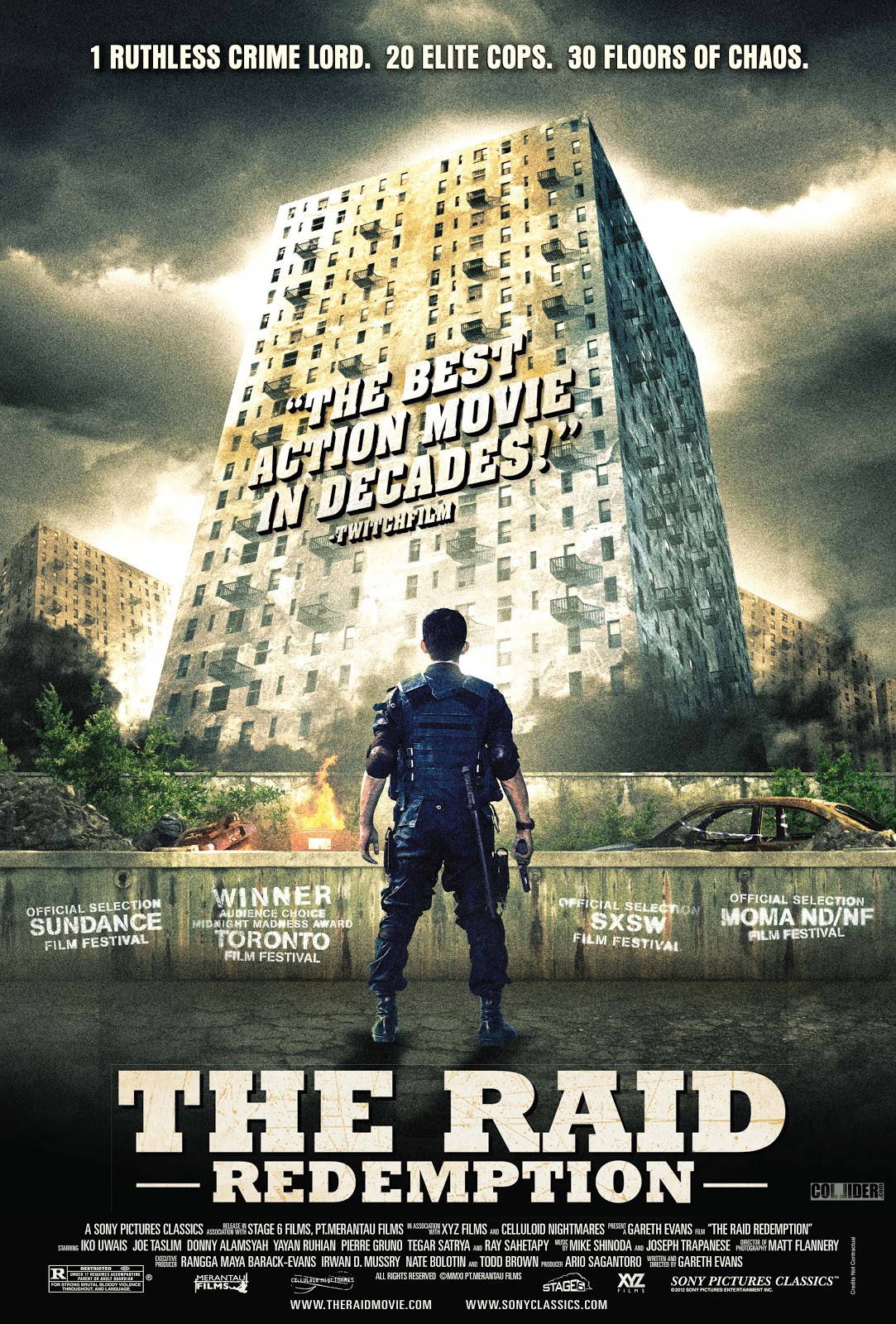
The Raid review


Mad Dog: Pulling a trigger is like ordering a takeout. 

Director: Gareth Evans
(2012)
When I went to watch the raid, I had set my expectations in accordance to the little I knew about it. Through various sources I knew that plot, character development and depth were almost nonexistent, with the action being placed centre stage. With this in mind I could appreciate the Raid for what it is, a riveting and intense action film.

Through the films first minutes we’re introduced to the films protagonist, Rama (Iko Uwais). Within minutes he is in his swat uniform and has joined up with the rest of his squad. Their objective is simple, reach the top of a tower block in the slums of Jakarta and capture the gang leader Tama (Ray Sahetapy) who resides there. Soon after the bloodshed has begun, the police team must fight for their survival as the gangs close in. This is about as complex as the raid ever becomes, it is very much a film with a simple story and even simpler characters. Thankfully director Gareth Evans cares not for such frivolities, and instead puts focus the stunning fighting style of Pencak Silat, a decision that has turned out to be the correct one.


The action is fluid and fast paced right from the get go. Ranging from 1 Vs 1 fights to massive one sided 12 man brawls. From the first gunfight, Evans paces his set pieces perfectly; they're close enough to each other to keep the audience interested, and far enough apart to prevent them from becoming overwhelming. The highlight is undoubtedly the meth lab brawl, with Rama and the remaining SWAT team beating down a bunch of scientists and junkies. The scene hits a strong climax as our hero runs across an incredibly long table that’s smothered in meth, clashing with gang member in a furious table top battle. The fight is brutal, the blows amplified by the clouds of the powered drugs that litter the air after every blow that connects, reminding me very much of The Matrix subway fight.

By the time the credits role, the Raid has done such a good job hiding its empty plot and lifeless writing by being a breathless and furious experience. In place of story is mind-blowing combat, where there should be character development there’s a stunning score from Linkin Park’s Mike Shinoda, the lack of gunplay is covered by tight pacing. If you manage to take The Raid for what it is, it’s hands down the best action film of the year.

Wednesday, 7 November 2012

Hanna review


Hanna: Adapt or die. 
Erik: Think on your feet. 
Hanna: Even when I'm sleeping. 

Director: Joe Wright
(2011)
Joe Wright isn’t a director who produces many films a year. While he isn’t as commercially lucrative as other more productive filmmakers, I find that when a director takes his time with his films by working on them one at a time they often turn out to be better, more enjoyable films. After my surprise at the quality of 2007s Atonement, Wright has done it again with Hanna, one of the finer action films of 2011.

 After her great performance in Atonement, Wright reunites with the talented Sariose Ronan, who has bounced back wonderfully after her shockingly poor turn in the abhorrent The Lovely Bones. She owns her scenes as the titular Hanna, a 16 year old trained assassin. She has lived with her father alone in the isolated wilderness of Finland almost since birth, being trained so that one day she could take her revenge on mysterious CIA agent Marissa Wiegler (Cate Blanchett). From our first shot of Hanna, we know she means business, and is one of the strongest female protagonists since Alien heroine Ellen Ripley.


The highlight of Hanna is the action sequences. Not a fan of shaking cameras and jumpy editing, Wright frames his fights well, and lets them play out in real time.  Sariose Ronan certainly holds her own in these scenes, engaging with multiple foes in brutal hand to hand engagements. The undoubted highlight of the set pieces comes from Hanna's father Erik (Eric Bana). Upon arriving in Germany, we witness a single, unbroken tracking shot from exiting the train station all the way down to a subway station, where he engages in a fight with 4 of Marissa’s goons. If there was ever a shot to rival the Dunkirk scene from Wrights Atonement, this is it. What amplifies the intensity of these scenes is the excellent original score from the Chemical Brothers. It’s purely electric, a factor alone that raises the tension before the during the fighting. What’s more of a credit to Wright however, is that while he does use the score to amplify tension, he follows this up by giving the viewer a worthwhile payoff, making Hanna all the more satisfying.

Hanna's biggest flaw is its dull and unfulfilling story that cant capitalise on a thrilling and well paced build up. The first 2 thirds are shrouded in mystery, feeding us only the basic information about Hanna, her father and their connection with Marissa. Once the final third rolls around, any unanswered questions are met in such a fashion that describing them as boring is a detriment to the word. The quality of the climax is lessened further by lacking a good action scene. Until now, every engagement and encounter has been delightful, but Wrights focus on trying to be clever seems to come before making a well rounded film.

On the whole, Hanna is much like Ronan's performance; an elegant blend of edgy, exciting brilliance. But it also resembles Blanchett's antagonist, armed with an accent so bad it almost devalues the entire character. Regardless of flaws Joe Wright has done a marvellous job with Hanna, and has given 2011 one of its finest action thrillers.